A speculative inquiry into the origins of God
2002
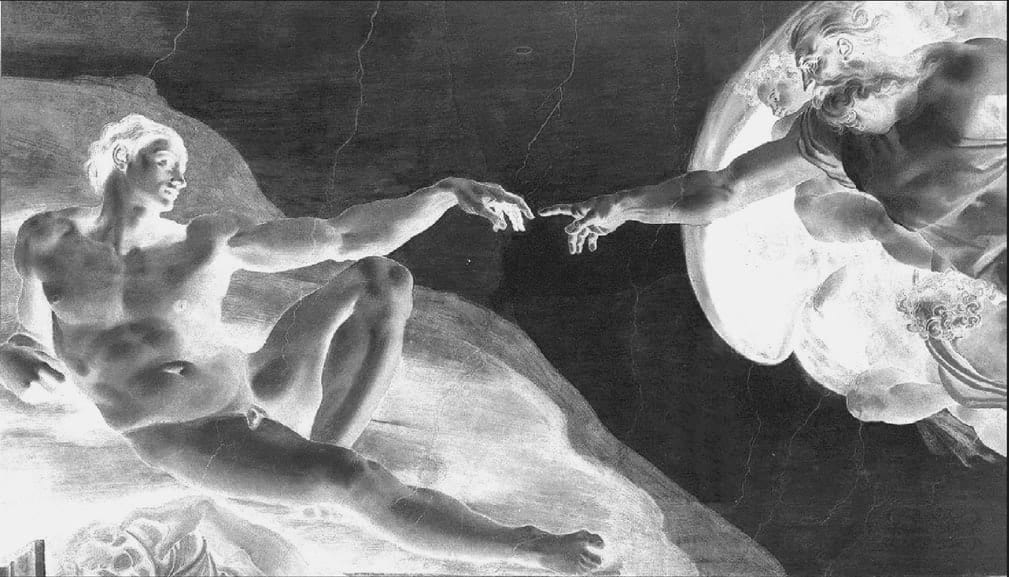
This essay attempts to preserve as clearly and fully as possible the ideas I have had over the preceding days, unblemished by any outside sources. Hoping that I and anyone else who gives a damn can, at some point, put these ideas to the test and see if this “revelation” actually stands up to the history books.
This all started one night when I decided to go online and look up the origins of the word “Christ” and somehow stumbled across the following quote from the scriptures,
"In the beginning was the Word, and the Word was with God, and the Word was God.” (John i. 1.)
I have run across this scripture countless times, but upon reading it this time, out of nowhere this wild idea came into my head. This idea being the central theme of the following… story, maybe? So I immediately started writing this idea down and as I did so, all these connections started popping up in my head and it seemed I could use the idea to explain many different things pretty readily.
To get to the point, the idea that came to me basically went something like this, “What if the God of the Hebrews and Christians (and maybe even several other monotheistic religions, as well), in fact comes from a legend based upon an actual man who once lived many many many years ago. And what if this one particular man, of all people, created (or discovered, if you like) language (or in more direct terms, “the act of labeling”)? And what more obvious first label for this man to choose than to label himself? And what if the concept of “The Word of God” represents language, itself?” (Sorry for so much all at once, but that might give you an idea of how I think.) Going on this premise, I started building a grander and grander theory…
I would first like to put forth the suggestion that the creative impulse of this man to label himself could have come as a direct result of some sort of psychedelic intoxication. I think maybe this guy stumbled across some interesting mushroom or the like, decided to eat it, and had some groundbreaking experience that while in a state completely altered from what he ever imagined led him to perceive of his own being. This left him with a need to share that knowledge with others. In a way, you might even say with a lot of blind speculation that this guy could represent the first shaman (or the first alchemist or magician, even the first psychiatrist, Christ, Buddha, etc.). You can hypothesize about a wide range of psychoactive plants that our man could have stumbled across and, in all his wisdom, decided to put in his belly. Whether he had any idea of what the plant would do to him goes beyond my means to speculate, but for now, let us assume that he did not know.
Let me state from the beginning that I fully recognize that a complex process probably took place over a long period of time for a language of any sort to first develop, with or without the involvement of psycho actives. Of course, I fully acknowledge that language could have developed in several places at once. I cannot say I know for sure (or have any clue) exactly how language developed right off hand. Nevertheless, I do not think this discredits my theory at all. I feel it in fact seems as though it might support it. I have found two ways we can begin to explain this predicament. Either we can assume that my God character completely discovered the act of labeling and then shared it with others, who then utilized that ability to create their own languages; or we can say that a bunch of people all over the world came up with this same idea at different times and created the first languages. Nonetheless, I will surmise that my proposed creator of language developed the language that maybe one day evolved into the Hebrew tongue and probably countless others. Thus, what became the religions of the Hebrews and probably others came to worship this man as the creator, God.
For the sake of my theory, I will attempt a simple summary of the development that corresponds to my premise… First man had to develop the concept of distinction, which means seeing ones surroundings not just as surrounding, but as ”things”. Hence, this led him to conclude his own separateness from those things or more simply, his own being; the concept, “I AM”. Moreover, from this point he would have had to go on develop “mental labels” to distinguish himself from all the “things” around him. I think “I AM” translates very clearly to this day into the concept this man had of himself which led to his own “mental label” given to himself so as to separate himself from his surroundings. Next, he would have to start to give “mental labels” to all of the “things” he began to notice around him. At some point, the man had the urge to share these concepts (“mental labels”) with others. Therefore, the best way he eventually found to share these labels ended up as vocalization.
In my proposal, the first labeling vocalization would have represented the concept of “I AM” and therefore, I think, might very well have sounded like “Ah”. So at some point, this guy ran around screaming “Ah” at everybody and pointing to himself. Hey, wait a second! “Ah” sounds an awful lot like “I”, the English word that one uses to describe oneself! What if Southerners unknowingly using the true name of God to describe themselves each day end up therefore, I guess, blaspheming on an incredible scale? Let us just assume that this “name”, “Ah”, one way or another developed into something like “Yah”, actually a root of the Holy Hebrew name of God, YHVH (pronounced “Yah- weh”). Moreover, doesn’t it seem incredibly convenient that we can literally translate the name of God as meaning “I AM”! Of course, to backtrack a little, we do not have to change our name “Ah” around at all for it to seem to resemble a root to “Allah”, the holy Muslim name for God (of course, I have no grounds for knowing that as fact). Maybe, with research, one could prove this true and then find more culture’s names for God with this root, and then maybe correlate the languages. However, do not count “Yah” out yet; I think it possibly appears like the root for “you”, the Spanish “Yo” which means “I”, and of course, who knows what else.
Shit! Putting off writing a little and looking at this website where I found the quote (http://www.infidels.org/library/historical/kersey_graves/16/chap23.shtml), I saw that an ancient Chinese text says something about God “saying The Word and his reality springing into existence”, and here a Tibetan script speaks of "the Word which produced the world", and countless others follow. I would think these absolutely must symbolize the birth of language and thus the act of discrimination! And now remember the original quote, “In the beginning was the Word, and the Word was with God, and the Word was God." You can choose to take “The Word” in these quotes to mean language, itself, or you can take it to mean this man’s “name”, the first word, “Ah”. I prefer to think both would apply.
Delving from there right into the Bible, I will now follow the next logical step and speculate that the story of “The Creation” actually comes from this man’s labeling everything around him (evidently starting with himself). In a very definite sense, the first acts of labeling completely exemplified the act of creation that the Old Testament speaks of. And so, God named the Stars, God named the Earth, God named the animals, and so on and so on. These items essentially did not exist in the collective human consciousness until they received labels. And so in a very real way, this created the central human view of reality (or “reality tunnel” as Timothy Leary would say) that we all still live in today, or to put it in the language of the Bible, this looks like “the creation of the universe”. He could have verbally labeled everything for his own edification at first, or he could have labeled everything so he could communicate about it all to others, but probably a combination of the two along with other factors.
Before I go any further, let me start by trying to sum things up a bit thus far with my own little version of “The Creation”. Remember: This story attempts to quickly and fancifully explain a process that I would imagine probably took place over quite a period of time…
Let us imagine that one day a long long time ago lived a young hunter. While not one of the
best hunters in the pack, he possessed a strong curiosity and did his share for the pack. One
day while wondering alone through the woods, he happened to stumble upon a strange, bright
colored plant. Without thinking about it, he popped the thing in his mouth. About an hour
later, while experiencing sensations he could not possibly comprehend, this man came to a
startling conclusion, “I AM!” At the same time that this epiphany (THE Epiphany?) struck his
mind, a sound escaped his throat, “Ah!” He contemplated this notion again, and again even
louder came the sound, “AH!!” After repeating “Ah” for a while, he had another new thought,
“The Others!” He had to let them know!
He ran back to where they camped at that time. He sped over to the others jumping and
pointing to himself and screaming, “Ah! Ah! AH!!” But the others did not understand what
his crazy actions and sounds meant. After a while, he finally gave up and went back into the
woods. After stumbling around in the woods for a time, he came across some more plants like
the one he had eaten. He looked closely at one of them and noticed different colors to it, specs
of one bright color on top of a background of another differently bright color. Then he looked
up in astonishment as he realized all the colors surrounding him. An innumerous amount of
color enveloped him! And even his self had incredibly distinguishable colors and textures of
its own! More curious than ever, he ate the oddly shaped plant right there and then two more.
After an unspeakably terrifying several hours, which for him had seemed like an eternity
(especially since he possessed no concept of time), utterly convinced that he felt his self dying
or that it had already died. After vomiting several times and at last passing out, he eventually
awoke and he could barely see a thing. “Dark”, he thought to himself. He felt hungry, so he
decided to feel around for possible food, but he could only find another one of the bright
colored plants around him and he really did not want to more around too much in the dark. He
held the plant up in front of his face and tried to see its bright colors in the dark. As he
strained his eyes to see the plant, it started to become visible. And so he strained even harder.
As he labored to see the strange colors of the plant again, something eventually clicked, and he
smiled. “LIGHT!” he thought.
In time the Light grew bright enough that he saw that it came not from himself, but from above
him. He relaxed and looked towards the Light and saw its source, the strange dimly glowing
orb floating above him. He considered the thing for a long while and eventually came to a
strangely familiar conclusion, “MotherLight!” at the same time saying, “Mah”. But then, he
noticed another light growing behind him. He turned to face this light, but could not locate its
source. After he waited for a while, a Light much brighter than MotherLight eventually came
into view. “FatherLight!” he thought in astonishment, speaking,”Sah”. As he looked into the
“Sah”, he thought again of himself. “I AM”, he mused. “Ah”, he spoke.
Eventually he turned his gaze away from the brightness of the FatherLight and looked down
towards his feet and he noticed the ground he stood upon and he looked around and saw that
the ground went on as far as he could see. “Earth”, he thought. He then noticed all the plants
growing on the earth, all different shapes and sizes and colors; they also went as far as he
could see. “Plants” he decided. He looked at the other creatures in or on the plants and on the
ground and in the sky. They certainly seemed different than his self and the Others, and they
definitely did not appear to be the same as the Plants, either. “Animals”, he decided.
At this point, he remembered that he still held something in his hand. He opened his fist and
saw that he had forgotten the now somewhat compacted strange Plant. He studied the Plant in
his palm for a time and finally thought to himself, “Plant of Knowing!” and popped the thing
in his mouth.
So thusly, I have demonstrated the act of creation. For the first time, the act of discrimination takes place and man gets inextricably separated from the rest of reality. So now, our man, “Ah” has to teach everyone else how to discriminate and use these labels… For now, I will simply jump to the conclusion that he systematically taught them the concepts over time until they clicked; the same as you would teach a child, or the blind and deaf and dumb. (See the Helen Keller movie for reference, or the “South Park” episode about the Helen Keller story for a much funnier reference.) Therefore, the creation of Adam and Eve might could reflect our man showing everyone else this new reality tunnel he has discovered and consequently teaching it to them. Simply put, in order to learn the art of language and connect the name to the man, the others should essentially have had to have to completely associated the two to the point where they believed the label and the object it represented totally one and the same.
For it to work, the mental label and the thing must correspond as indistinguishable. In this case, the labels came in the form of the vocalizations this man taught them. Therefore, his “words” became their “mental labels”. This would in essence generally reflect the same way in which we still learn language today. I think our guy probably might have seen beyond the labels, because of the level of consciousness he had achieved. As the one labeling, and therefore performing the act of discriminating everything for everyone else, he could tell the difference between his vocalizations and what they represented; but remember that he still believed himself separate from his experience/surroundings, and he probably still fundamentally believed his “mental labels” indistinguishable from the objects that they represented. But as you can see, his “mental labels” did not transmit to the others; they got their “mental labels” from his language.
Let me say at this point that I think that before this “event” of Man choosing to label himself took place, humanity pretty much existed close to the conscious level of animals; it did not separate itself from its experience, it did not recognize its own existence. Or if you want to get scientific, you could say they had only advanced through the first two systems in the Leary/Wilson 8-System Model of Consciousness. In the First System, notions of the perceived friendliness or harmfulness of the outside world get set (reserved, timid / explorative, outgoing). In the second system, personal concepts of personal self worth and status develop and get determined (top dog / runt of the litter). Every living animal has reached at least this level of psychological development. (See http://tetrica.com/misc/circuits.html for a full explanation of the Leary/Wilson Model.) An even more direct description of what I imagine it would have seemed like would come from Freud’s concept of “The Oceanic Experience”. So, like the rest of the animal kingdom, until this event took place, human consciousness did not extend beyond this point.
Without too much wild speculation then, I can conclude that this looks a lot like the dawn of the great dichotomy that brought Homo sapiens out of the ranks of the animals and into the realm of the thinkers. Humanity distinguished itself from its surroundings and started labeling everything around it, essentially deciding that each thing labeled existed separate from the rest of their experience. This, then, would represent the birth of the Third System in the Leary/Wilson 8-System Model of Consciousness. By distinguishing himself and thus starting to distinguish his surroundings, Man begins to map his environment and categorize all that he encounters, quite possible beginning to assess for utility. For the first time, what one can describe or what one can successfully transmit becomes central and “knowledge” comes into existence. Man starts making connections and associations in his mental labels and starts the process of critical thinking.
So what about everyone else? When do they come into play? For the answer to that, I will go to the story of Adam and Eve. On the one hand, I have a strong liking for the theory that the story of Adam’s rib becoming Eve comes from the memory of the very first cells that successfully split and replicated successfully enough to eventually evolve into all life today. However, leaving that part alone, I can very convincingly apply other parts of this story to my theory. Again, I will make a few more wild speculations and assert that “Ah” did not share his special plant to help teach the others to discriminate, for they did not discriminate, at all. As I said before, I think they completely associated the “thing” with the “name”, so in that sense, “Ah” did all the work for them. Thusly, He decided that he did not want to share the Plant of Knowing. He got greedy. Only he had the power to label and the others worshipped him for it. He became the first leader of men and he taught the others that they should never partake of the plant. However, a few people naturally ended up eating the plant anyway and gained the same power to “name” that he possessed. Out of scorn, he quickly banished these people out of his kingdom. (One could make an even crazier conjecture at this point and guess that these people went out and formed the other root languages of the world.) Therefore, in a real sense they got kicked out of the paradise that “Ah” had created for everyone (or at least for his followers), the paradise of his language.
Going on that note, the exact same pattern seems to get repeated with the rebellion of Lucifer and the renegade angels and their eventual exile from Heaven. I will even go out on a limb and speculate that the stories of all the “angels” could possibly come from legends about a select few that “Ah” decided to allow to eat from the special plant, or a few that he allowed to create verbalizations. On the other hand, maybe the stories just come from the legends of his closest friends or the like. Perhaps the stories of the renegade angels and Adam and Eve both represent some follower that for one reason or another turned against “Ah” and eventually got cast out from his “kingdom”. Maybe the idea of Lucifer comes from the tale of a real man who yah made his first apprentice, who eventually turned on him, but that really pushes it. Moreover, maybe the idea of Hell comes from the exaggerated accounts of these outcasts’ own settlement. Lo and behold, we have “Paradise Lost”!
One has to ask, “Who knows how much fluff and BS has gotten added to the stories in the Bible over the years?” The good book has most certainly received countless edits to make it fall in line with the ideas of the rulers of time over the centuries. So, we should try to somehow manage to peel away all this excess crap and start by declaring that everything involving some booming voice from the heavens and the like has nothing to do with the man “Ah” we imagine. (But most likely has everything to do with some guys much later on in Time getting their hands on some psychoactive plants of their own and “meeting” what they perceived as this over hyped divinity.) I believe then, that only the earliest stories of YHVH—parts of Genesis, and possibly a little more from the Old Testament and a few other scattered sources, would contain any useful material about the true origin of God; at least useful for the purpose of this essay.
So how can we account for the vast differences between the God of the Old Testament and the God of the New Testament? The Hebrew God reads like one mean cocksucker. Throughout the Old Testament this one main character trait stays apparent. Striking down whole cities and smiting all that incurred his wrath, demanding sacrifices and exacting obedience from his followers for fear of their lives. This dude just does not come off as a very nice person! However, when you get to the New Testament, lo and behold, the God that Jesus spouts on and on about does not seem like quite such a bad fellow. In fact, the Christian God seems pretty swell! That seems strange… How can we explain this personality switch? Well, we can with my “Ah” theory. Just read on.
Well, thus far in my supposition, if you buy the Adam & Eve or Lucifer theories at all, “Ah” has already shown a little bit of that vengeful wrath that we have come to know and love from the God of the Old Testament. Whether or not that rings your bell, let’s just jump to the conclusion that as the first leader of men, “Ah” behaved like a fucking bastard! The power he had gained as the one who had fashioned the world for everyone else went straight to his head and he ruled his followers with an iron fist. He demanded absolute devotion from his followers and they had to conform to his every wish. Maybe the concept of sacrifices evolved from his demanding of meat from his followers! So let us assume that the legend of this ruthless asshole, “Ah”, that created this very reality grew and grew over the decades until mankind remembered him no longer as a man, but as GOD.
Most Christians assume that the God that Jesus talks about in the New Testament no different from the God of the Old Testament. I think this one of their fundamental mistakes. Although I think that the New Testament has certainly gotten tampered with almost as much as the Old, things certainly come out a lot different when coming from Jesus Christ. I find the teachings of Jesus much more in line with Buddhism or Taoism. The key to this understanding comes from knowing that Jesus used the idea of “God” as a metaphor for essentially the universe, itself. In technical terms, the idea goes something like this: Everything in existence seems to break down into essentially one constant flow of energy. This energy theoretically appears to comprise of consciousness itself. So we can then decide to describe that consciousness as “God”. Jesus even clearly stated (something like), “I am the son of God, we are all the children of God.” His words obviously symbolize an attempt to express everyone’s connectedness to the collective unconscious, the unknowable whole, or the energy of consciousness that makes up all of existence. Several books and probably several web sites exist that profess that Jesus spent his lost years in the Orient; this would make a lot of sense.
And so, I can use my theory to relatively effortlessly explain the differences between the two books of the Bible. I can creatively correlate the stories of the Old Testament with my supposed legend of a temperamental old leader who one day declared himself “Ah”. In contrast, the New Testament seems to speak in metaphor and symbolism; in actuality, talking about learning to look past this reality that “Ah” has created, attempting to live a life that feels harmonious to a deeper reality beyond the world of illusion created by labels.
For even more confirmation of my theory, let us consider the beliefs of Gnosticism. As I understand it, Gnosticism developed out of Judaism around the same time as Christianity, maybe even much earlier, and shares many of the same fundamental core beliefs as early Christendom. But what truly distinguishes Gnosticism and makes it important to this essay? This: Gnostics fundamentally believe that the material world that we perceive and live in acts as a kind of illusion put forth by some sort of false God, claiming to be the true creator. This illusion masks the true heavenly nature of all facets of everyday reality, so human kind does not know of their true holiness and live as this false God’s slaves. (Or at least something along those lines!) Now going on that basis, this false God of the Gnostics certainly sounds like our new God of Labels, Yah! And the world of illusion certainly sounds like the reality we exist in as a consequence of distinguishing and labeling—language! So, according to my theory, maybe the Gnostics had it right all along, except for one key fact—they looked to blame some sort of daemon from outer space for our reality of delusion, when they should have realized that the real culprit, naturally, could only end up as a human!
And so concludes my “proposal” as it stands. As for myself, I still haven’t figured out what to think about it. Read up and decide for yourself if any of this holds water, if you give a damn. I have shared all I think I know on the subject and so now, I put it in your hands to decide. I feel that possibly, with time and actual research, much more could come from this, but I think I have taken it about as far as my own knowledge and ability can with no actual investigating... With luck, I hope I that have stumbled upon a giant puzzle piece that as of yet went missing, but of course I find that incredibly hard to believe. When I do actually get the nerve up to study up and see if my ideas suck, maybe I will actually find something worthwhile and delve deeper. As for now, I will settle for a couple of new theories of at least some minor comedic value. Why not?
Appendix A: Outlines of Theories Proposed (with some extension)
I have attempted to place the various theories put forth in the above essay in a chronological order, also showing the level of dependence from one theory to the next. I created a component structure so that one can pick and choose which theories they like simply by ignoring unwanted theories and their subsequent theories.
Theory Set I – The Origin of “God”
The Hebrew/Christian (and possibly others) God comes from the ancient legends of the first man (or one of the first men) to develop language (See Theory Set 1.2 for a simple breakdown of the development of language) and successfully teach it to others (See Theory Set 1.1 for my theory on how came to develop language)
- This man’s first vocalization represented the concept “I AM” and evolved into the Name of God
(Theory Set 1.3)
- As this man created language to describe the universe around him, he essentially performed “The
Creation” of the Bible (Theory Set 1.4)
- Through his innovation in creating language, this man became the first leader by intellect (Theory
Set 1.5)
3.1. Others around the world could have done the same at different times
3.2. To accord to part of the Adam & Eve story and the story of the Angelic Uprising,
Some his followers him went against him or his wishes and got outcast (See Theory Set 1.6)
3.2.1. Some of these outcasts went on to start languages of their own
- The legends of this man grew into religion
Theory Set 1.1 – The Psychedelic Connection
To develop the concept of labeling this man could have
- Ingested or by some other means absorbed a psychoactive substance
1.1. Entered into an “Altered State of Consciousness”
1.1.1. Recognized himself as separate from his experience; or surroundings
1.1.1.1. Come to the conclusion of being; “I AM”
1.1.2. Recognized the “separateness” of everything around him
Theory Set 1.2 – Simple Language Development
To get to the point of developing language, I think this man first had to
- Come to the conclusion of his own being; the concept, “I AM”
1.1. Recognize the separateness of all the “things” around him; what I have called “the act
of distinction”
1.1.1. Create “mental labels” that associate or describe first himself and then the
“things” around him (This step might have taken place synchronously to step 1.)
1.1.2. In an effort to share his “mental labels” with others, over time develop
vocalizations that corresponded to each “mental label”, thus language
Theory Set 1.3 – The Origin of “The Name”
The first vocalized word developed by this man symbolized the concept “I AM”; or meant to
distinguish his self from the others and everything else
- This “word” sounded something like “Ah”
1.1. This “first word”, “Ah”, eventually became recognized as what we in the modern era
would call this man’s “name”
1.1.1. This “name” that sounded like “Ah”, eventually developed into something more
complex, like “Yah”. From there it evolved into:
1.1.1.1. “YHVH” (“Yah-weh”), the holy name of the God of the Hebrews
1.1.1.2. “Allah”- the holy name of the God of the Muslims
1.1.1.3. And theoretically many more names for God
- Down through the legends of this “word” we have conceived of the notion of “The Word” as
in, “the Word was God"
Theory Set 1.4 – The Real Creation
The act of “The Creation” as recounted in the Bible has evolved from the stories of this man
giving names to all the objects he started to notice
- He created language and gave himself a name
1.1. In order to associate the man with the name, the others had to come to believe them one
and the same; thus starting the process of “creating” their universe(s)
1.1.1. He went on to create their world by giving them a way to distinguish each item
around them; probably starting with the obvious like the earth, the sky, etc.
Theory Set 1.5 – The First Leader
With the social power he gained by being the sole creator of language and maybe the universe, this
man became the first leader to take charge in an intellectual manner
- He maintained his power by forbidding his psychoactive substance from his followers (See
Theory Set 1.6)
- As a ruthless leader, he demanded tributes from his followers and did not treat them well in
general
2.1. The concept of sacrifices comes from his requiring tributes of meat and then whole
beasts from his followers
2.2. The much exaggerated legends of this man reflect the personality of the God of the Old
Testament
2.2.1. The God that the New Testament refers to does not reflect the God of the Old
Testament
2.3. The False God of the Gnostics evolved from this man’s legends
Theory Set 1.5.1 – The Rebellion
Several of this man’s followers turned on him or went against his will. This receives support
from:
- This man “received” language from a psychoactive plant (See Theory Set 1.1) and began
to spread it to others (See Theory Set 1.4)
1.1. He took control of the others in his “pack” (See Theory Set 1.5)
1.1.1. Realizing the power of the plant others and he forbid them to eat the plant
1.1.1.1. Some of his followers went against his wishes and ate the plant
1.1.1.1.1. These followers gained the ability to distinguish for themselves
and thus learned the art of labeling. (They saw beyond the labels)
1.1.1.1.1.1. They rebelled against him
1.1.1.1.1.2. This man kicked them out of his “kingdom”
1.1.1.1.1.2.1. They went on to create other languages that spread across
the World
- This man used his influence as the creator to take control of the others (See Theory Set 1.5)
2.1. He allowed a few of his followers to use his psychoactive plant (See 1.)
2.2. Several of his followers used his plant without asking (See 1.)
2.3. Several of his of his followers rebelled against him (Maybe either of the above)
2.3.1. His forces overthrew them and they received banishment
2.3.1.1. The legends of their supposed “encampment” evolved partly into our
concept of Hell
Appendix B: An anonymous critique of “The Legend of Ah”
The Legend of Ah
I disagree with the theory because I believe that psychedelics are unnecessary for the formation of language and I know that language has had an incredible amount of change over thousands of years.
The writer begins by saying that he believes that a psychedelic caused man to see himself as separate from the world and thus language was born. I believe that language was born from the need to control others. That is to tell them what to do. When a group when to hunt, the leader would be limited if he only used hand gestures to tell his followers what to do. He would want to identify things and actions. At sometime, he would want to name his followers so that he could tell someone to bring that person to him.
Much of the discussion is based upon the idea that "Ah" sounds like a present day word, a word that has been in use for a short period of time. Are we to believe that "Ah" evolved into other words and eventually evolved into the same word? If he thinks this happened, he should say so.
Additionally, I believe that the words are meant to mean exactly what they say. That is, we have the potential to say a thing and have it happen. For example, when Jesus fed the great number of people with a few loaves of bread and a few fish. His belief made it true because his belief was strong enough to allow him to make it happen by merely saying it. I believe that we all have the potential to create such miracles once we have achieved Jesus' level of spirituality.
Additional comments
I have several other problems with this essay: the format, the lack of research, the use of vulgar language, and his attitude toward the reader.
First, the format: In the beginning he rambles and is difficult to follow. Because he also uses incorrect punctuation regarding commas, the reader wonders about the education of the writer.
Next, his lack of research is obvious. When he begins by saying that he has not researched his theories, I wondered why he had written so much without researching it. After reading his booklet, I was sure that he researched nothing. I opened the cover of my dictionary and saw the "Tree of Language." The tree shows the accepted theory of evolution of all languages form one language. He talks of "ah" as if it represents "I." However, "I" is new to the English language and is nonexistent in other languages.
When a person feels the need to use vulgar language in order to make his point, people listening to him wonder about his level of education and the accuracy of his claims. When a writer uses vulgar language, we assume that he has had time to rethink his theory and wonder why he insists upon insulting the reader.
He treats the reader impolitely by saying, "look that one up yourself." The reader knows that he can check the information without being ordered to do so. His use of vulgar language also shows a lack of respect for the reader. His boasting that he did no research shows lack of respect for the reader. In the last paragraph he says, "But unless you know... a lot about the subject, I would at least ask a whole lot of reading..." in other words, "you need to research, I don't." This thought is emphasized by his comment inside the front cover where he brags that he wrote it all in three nights.
No name given.
Appendix C: A response by the author with further commentary
Dear Anonymous,
Thank you for your response to my paper. It delights me know that someone has taken the time to open the dialogue that I had hoped my essay might spark. Up until this point, I have had no input, save for a few of my closest friends, and thus have had very little opportunity to see how clearly my intended message gets transmitted to those that have not already become vexingly familiar with the concepts I have attempted to get across. Unfortunately, judging from your rebuttal, I conclude that my language (no pun intended) has not reached the level of clarity I had hoped for it to achieve.
Let me start by attempting to clarify what I perceive as some misconceptions about my own beliefs. In my own life, I strive to live by the motto “believe nothing”. I feel that this outlook keeps me from completely accepting any given explanation so that my mind will always remain open to different ones. In my essay, I very carefully picked my words in an attempt to convey the fact that I do not “believe” any of the theories I have put forth; precisely the reason I call them theories. In fact, I only use the phrase “I believe” once in the entire essay, so I have a hard time understanding why you presume that I believe the theories I have presented. When dealing with the particular subjects that my essay addresses, we probably will never or can never have any definite explanations. Therefore, we can rely only on theories. I think some of them more probable than others, but as for belief in any explanation given in my paper or otherwise, I have none. In contrast, you state very clearly in your response that the majority of your arguments stem from theories and assumptions that you have accepted as fact, using the phrase “I believe” over and over again.
The first argument made in your rebuttal states, “I believe that psychedelics are unnecessary for the formation of language”. The first response to this statement that comes to mind would ask, “How do you know? Research? Do you have any proof?” Secondly, I would say that I totally agree. This theory seems pretty valid to me. My paper never once stated that a psychoactive substance directly caused the formation of language. In fact, the paper has at least attempted to say that a psychoactive may or may not have played a role in the inevitable development of language. In reality, my “psychoactive theory” has absolutely nothing to do with the rest of the theories presented in my essay, with the exception of the “Adam & Eve theory”, which directly relies on it. Actually, psycho actives have an extremely small, if not altogether separate, role in the grand scheme of my entire theory. If I had intended “The Legend of Ah” to scientifically and concisely present my theories, besides doing an unimaginable amount of research I would have saved the “psychoactive theory” for an entirely different paper. If you truly dislike drugs, you have the complete freedom to simply disregard those portions of the essay as extremely unlikely. However, you cannot disregard them as totally false. I challenge you to present me with definitive proof to prove otherwise.
You go on in your response, I assume as proof that psycho actives had no role in the creation of language, to present your own belief as to the origin of language. Going on that assumption, and since your reply makes no mention of it, I conclude that you have disregarded the rest of my theories on the origin of language. That aside, I personally found your theory of language as a means of dominion quite interesting. I find it integrating quite well into my own ever-adapting theories. Of course, once again, you provide no research to back this idea up. As your only evidence against my theories thus far, it appears to me that you have presented nothing more than several other equally valid theories; and it would seem as though you offer your own belief in these theories as your only proof of them. The next criticism in your rebuttal centers on words and the evolution of language. In you very first sentence you state, “I know that language has had an incredible amount of change over thousands of years.” as your second main disagreement with my essay. This argument perplexes me. Where in my essay, even at the very least, did I ever imply anything to the contrary? I would say that it goes without saying that language has changed drastically over the millennia. Consequently, I must assume that your statement refers to the rather confusing argument your rebuttal makes against my theory that the word “I” (and several others, by the way) could have evolved from the name “Ah”. Here, once again, it seems that you have focused on what I see as a very miniscule portion of the entirety of my essay. In fact, you even go so far as to say, “Much of the discussion is based upon this idea.” Well, looking at “The Legend of Ah”, I can only find mention of this particular theory in just one sentence, two if you count the joke that follows (of course it does get mentioned one more time in the outline at the end).
Nevertheless, since this particular theory seems so completely detrimental to your acceptance of the rest of my hypotheses, I will attempt a response to your argument. You argue that the word “I” has recently emerged in the English language according to the “Tree of Language” in your dictionary. I have looked in several of my own dictionaries and searched the internet, and could find no “Tree of Language”. Failing that, I went and got out my etymological dictionary and looked up the word “I”. Strangely, I came up with very different results from your own. According to my book, the word “I” has definitive roots going all the way back to the Old English words “ic” and “ih”. To go on, these words have direct relations to the German “ich”, the Icelandic “ék”, the Latin “ego”, the Greek “egô”, and most interestingly of all, the Sanskrit “ahám”. So, as far as I can tell, the word “I” certainly seems to have a hell of lot more of an evolutionary history than you have given it credit for. A quick search online confirms this. I would also say that this new information certainly seems to strengthen the “Ah” theory rather than disprove it.
You point out that your “Tree of Language” speaks about what it claims as the accepted theory of the evolution of all languages from one. I must ask, how do you intend this to invalidate any of my theories? Hell, if anything, it supports it! If all languages evolved from one, then maybe they all evolved from the language created by “Ah”. This would make his achievement all that more miraculous thus making him even more God-like.
Although I find myself extremely unsure of the relevance of your fourth paragraph, I will do my best to respond. You start by stating, “I believe… we have the potential to say a thing and have it happen.” You then give the example of Jesus miraculously feeding innumerable people with a tiny supply of bread and fish all through what you posit as the power of the strength of his belief in his own words. I agree to some extent with these statements, but I also disagree. I disagree firstly because I think speech has nothing to do with the “abilities” you talk about. Secondly, I disagree because I think that Jesus’ strength of will gave him the ability to make this happen (if he even performed this miracle), in combination with his un-belief. I would think that Jesus, like any truly enlightened individual, would have seen any “belief” as a limitation. I contest that only when one has let go of all his beliefs can he truly accept that has the freedom and ability to do anything he chooses. If you believe in something, then you have no control over it. I prefer this version of you first statement—“I think maybe we have the potential to will a thing and have it happen.” The “power” to perform “miracles” comes not from speech, or even from thought. It comes from that which comes before thought; this combined with un-belief, which results from an absolute will.
The next complaint you have with “The Legend of Ah” regards format. You say that you find the beginning of the essay hard to follow. Since reading this, I have reviewed the essay several times and in my view, I could only find one paragraph that I could conceive of as “rambling” and hard to follow: the paragraph wherein I present my original idea. As I stated in the essay, I had attempted to present the idea in the original stream-of-consciousness manner in which it came to me, and once again, I apologize if you find it hard to follow. You also question my education with regards to the use of commas. Upon review of the essay, I did find two or three sentences in the beginning where I indeed did get a bit over zealous with the commas when I should have just had two separate sentences. I thank you for pointing these overlooks out to me, although I hardly think they warrant calling my education into question (nonetheless, I assure it as sufficient.)
You then go on to point out that my “lack of research is obvious”. I should hope so. I say it right there in the very first sentence! You wonder why I have written so much without research. Well, if you read the second to the last sentence of the very first paragraph, you will see that I wrote “so much without actually researching it” with the goal of attempting to completely capture the stream-of- consciousness flow of ideas that I had. In that frame of mind, I felt that any research would have inextricably altered my flow of ideas and therefore compromise the paper. In addition, your tone in this area seems to imply to me that you assume that, because I have done no direct research for this particular paper, I have no real knowledge of the subjects about which I talk. I assure, you that I consider myself at least pretty well versed with these topics; otherwise I would not have the capacity to write “so much” to begin with. However, I did not want to make a statement like that in the essay, lest I come off as sounding arrogant to reader like yourself.
You next criticize the essay for one of my favorite subjects, the use of vulgar language! You declare, as though it had come out the mouth of God, himself, “When a person feels the need to use vulgar language in order to make a point, people listening to him wonder about his level of education and the accuracy of his claims.” —I had no idea that you had leave to speak for the entire human race. Obviously, this issue depends entirely on each separate persons own ideals. Personally, I do not believe in vulgar language. I would hope that by the twenty-first century, humanity has finally started to stop getting embarrassed or offended by the base human functions that we all share that these words represent. As you have already stated, language constantly evolves. I think these words have evolved beyond “vulgarity”. You make a choice to view the language as vulgar; I choose to see it as just language. In any effort as a writer, one must choose very carefully which words will most accurately describe the notions in ones head. I say, if “fuck” seems the best word for the job then I will write “fuck”, if “make love” expresses my concept better, then I will write “make love”. If I do write “fuck”, then you have every right to make the choice to stop reading. On the other hand, if I had intended to write a serious scientific paper, I would have used entirely different language throughout the essay, including the removal of “vulgar” language.
Your final complaint involves your view that the essay generally lacks respect for the reader. You first point out a passage where I tell the reader to look something up for them self. I had just gone through a very long description in the essay and had thought this statement would come out as funny; but I see now how it could offend someone. You then claim that I boast about the fact that I did no research for the paper. Looking at it now, I think that maybe in my effort to make the purpose and process of the paper as clear as possible, I drastically overstated this fact, even ran it into the ground. However, I never intended it in a boastful manner. Next, you present your own interpretation of my request to the reader to do some research before counting my theories out—“you need to research, I don’t.” This assumption could not seem any further from the truth. By making such a request, I had hoped to motivate my readers to withhold from making any premature judgments about the theories in the essay until they at least took the time to research them a little. I assumed that it would appear as obvious that the same applies to me. I do need to research, clearly. In fact, I all but make that exact statement in the very next sentence. Finally, you describe the manner in which the dates of the creation of “The Legend of Ah” get presented on the inside cover as bragging. How else would you have me present this information? Should I just not include this information, because it might offend the sensitive reader? I don’t think so.
Even though I feel that a good portion of your refutation of “The Legend of Ah” seems based on your own personal biases, I have found it very helpful in helping me to understand the implications of the language I choose to use and in expanding and clarifying my theories (at least in my own head). Moreover, the rest of your refutation has helped me further by exposing the areas I need to work on as a writer. I think the challenge alone makes me a better writer. Personally, I have had as much fun writing this reply as I did when writing the original essay. Thank you for this opportunity. I hope you will continue to contribute more insights and input into my further writings, pushing me constantly to improve my own abilities.